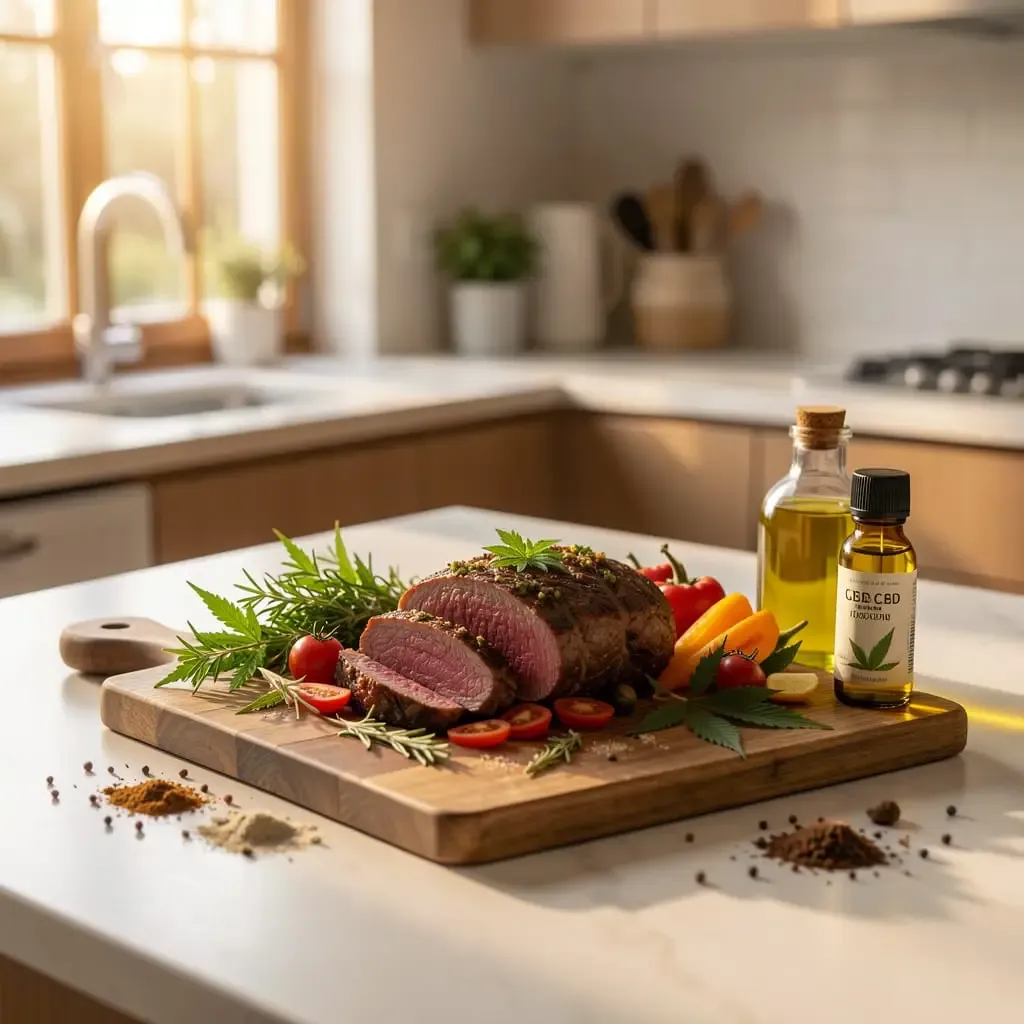
Cooking with CBD Oil: Dosage, Temperature & Flavor Guide
Key Takeaways
- CBD Oil is fat-soluble: it disperses and absorbs better when paired with a fat (olive oil, butter, cream, avocado) than when added to a watery preparation.
- Heat degrades CBD past a certain threshold: it’s best to add it off the heat or right at the end of cooking, never in deep frying or a very hot oven.
- To start, a dose of 5 to 15 mg of CBD per serving is a cautious baseline, to be adjusted gradually based on individual sensitivity.
- CBD’s earthy, herbaceous aroma pairs naturally with honey, dark chocolate, citrus, garlic, and fresh herbs.
- France’s regulatory framework for CBD food products evolved during 2026: it’s best to check the compliance of the product you’re using before cooking with it.
Cooking with CBD oil essentially means adding CBD oil to an existing dish rather than treating it as an ingredient cooked at high heat. Two rules govern everything else: CBD binds to fat, not water, and it loses quality once exposed to intense heat for too long. Once you understand these two mechanisms, cooking with CBD becomes as simple as seasoning a vinaigrette or flavoring a dessert with a slightly unusual aromatic oil.
This guide covers how to dose a homemade recipe, what temperature to work at to preserve the CBD, and which flavor pairings let you incorporate it without its taste taking over the dish. The goal isn’t to turn every meal into a CBD delivery vehicle, but to use it with the same precision a chef would use a food-grade essential oil or a concentrated extract.
Why Temperature Changes Everything with CBD
The Degradation Threshold to Know
Cannabidiol is a heat-sensitive molecule. The benchmarks that come up most often in the specialized literature place the onset of noticeable CBD degradation at above roughly 150°C (302°F), with quality loss increasing the longer the exposure. Below that threshold, over short cook times, CBD stays broadly stable. Beyond it — especially with prolonged cooking — some of the cannabidiol breaks down and the associated aromatics (Terpenes) evaporate first, which is why CBD oil heated too aggressively loses both potency and flavor.
This sensitivity isn’t unique to CBD: most flavored oils (good quality olive oil, herb-infused oils) behave the same way. The difference is that for CBD, the quality loss isn’t just about taste — it’s also why adding CBD oil at the end of a recipe makes more sense than adding it at the start.
Cooking Methods to Favor
In practice, three ways of incorporating CBD limit degradation:
- Off the heat, as a finishing touch on an already-cooked dish (a plated soup, roasted vegetables, fish straight out of the pan).
- At low heat, in a preparation that never goes past a gentle simmer — a sauce, a cream, a yogurt.
- Cold, straight into a vinaigrette, a smoothie, guacamole, or a spread.
Long cooking at very high oven temperatures, deep frying, and high-heat searing are, by contrast, the settings where CBD loses the most value: the heat is too intense and the exposure too long to preserve the molecule.
An Exception: Slow-Infused Preparations
Some recipes use a long infusion at a very low temperature (around 80-90°C / 176-194°F, never reaching a boil) to bind CBD to a fat — butter or a neutral oil, for example. This type of infusion, done gently over a controlled period, remains compatible with good CBD preservation, as long as the mixture never climbs above that low threshold.
Choosing the Right CBD Oil for Cooking
Full-Spectrum, Broad-Spectrum, or Isolate
Not all CBD oils behave the same way in cooking. A full-spectrum oil retains all of hemp’s natural compounds (secondary cannabinoids, terpenes) and has a stronger, more plant-forward taste. An isolate oil, on the other hand, contains only purified CBD: the taste is more neutral, which makes it easier to pair with already-flavored dishes, but also makes the oil less interesting for anyone specifically seeking that earthy note in cooking. In between the two, broad-spectrum keeps some of the secondary compounds without the traces of THC that a full-spectrum oil can contain.
For a first recipe, an isolate or broad-spectrum oil stays simpler to dose and incorporate, since the pronounced taste of full-spectrum requires a bit more practice to balance in a recipe.
Checking Concentration and Carrier Oil
Two pieces of information on the label matter even before choosing a recipe: the CBD Concentration (expressed in mg for the whole bottle) and the type of carrier oil (olive, hemp, MCT). A carrier oil that’s neutral in taste, like MCT Oil, leaves more room for the recipe’s other ingredients, while an olive oil base adds its own note and can reinforce the overall plant-forward character. This choice mostly depends on the dish in mind: a vinaigrette handles an already-flavored carrier oil well, while a dessert works better with a neutral base.
The Right Dosage for a Homemade Recipe
Starting with a Cautious Dose
Before calculating anything, one simple rule outweighs all the others: start small. A commonly recommended baseline for first-time use is between 5 and 15 mg of CBD per serving, to be adjusted afterward based on individual sensitivity, body weight, tolerance, or desired effect. This isn’t a universal dosage: every body reacts differently, and the goal of a homemade recipe isn’t to chase a maximum effect but a measured, repeatable use.
Calculating the Dosage per Serving
The most reliable method is arithmetic rather than guesswork:
- Check the concentration of the CBD oil you’re using (listed in mg of CBD for the whole bottle, on the label).
- Divide that total amount by the number of milliliters in the bottle, to get the mg-per-mL content.
- Multiply that value by the amount of oil used in the recipe.
- Divide the result by the number of servings planned.
This calculation avoids the most common pitfall in CBD cooking: adding the oil “by eye,” without accounting for the number of people being served, which can make the actual dose per serving vary widely depending on portion size.
Adjusting Gradually
Once a first recipe has been tested, it’s easier to adjust the dosage up or down from one time to the next rather than aiming straight for a high dose. Many users increase their dose in increments of a few milligrams, spacing trials out over several days, giving themselves time to gauge the effect before going further.
Why Pair CBD with a Fat
Fat-Solubility, Explained Simply
CBD is a fat-soluble molecule: it dissolves in fat, not in water. Added directly to a watery preparation (a clear broth, a water-based infusion, a juice), some of the CBD stays poorly dispersed and binds weakly to the mixture. Paired with a fat, on the other hand, it blends in far more evenly — which improves both the texture of the recipe and the consistency of the dose from one serving to the next.
The Best Culinary Carriers
Some ingredients naturally serve as a vehicle for CBD thanks to their fat content:
- Olive oil, for vinaigrettes, marinades, and finishing touches on vegetables.
- Butter, gently melted, for baking or a sauce.
- Full-fat cream or yogurt, for desserts and cold sauces.
- Avocado, for guacamole or a spread.
- Nut butters (almond, cashew), for smoothies and sweet preparations.
In every case, the CBD oil is stirred in right at the end of preparation, once the fat base is already in place and, if the recipe involved cooking, the temperature has come back down.
Flavor Pairings That Work
CBD’s Aromatic Profile
CBD oil has a recognizable taste: earthy, herbaceous notes, sometimes slightly bitter, close to those of a strongly flavored olive oil or an herbal infusion. This profile doesn’t pair with everything the same way, and the choice of pairing radically changes how the finished dish comes across.
Sweet Pairings
Honey, dark chocolate, citrus (orange, lemon), and vanilla effectively cover CBD’s bitterness while complementing it. A spoonful of CBD oil infused into warm honey, drizzled over a dessert or a tea, remains one of the simplest uses to get right: the sweetness immediately softens the plant-forward note without fully masking it.
Savory Pairings
On the savory side, fresh herbs (basil, cilantro, parsley), garlic, black pepper, and citrus work well because they already share aromatic registers close to CBD’s own — plant-forward, slightly sharp, a little earthy. A lemon and CBD oil vinaigrette, for example, naturally absorbs the herbaceous note rather than letting it stand out on its own.
What’s Best to Avoid
Very neutral-tasting preparations (plain rice, flavored water with nothing else added) let CBD’s profile show through with nothing to balance it, which often makes its bitterness more noticeable. It’s better to incorporate it into a dish that already has character rather than adding it as a last resort to a neutral plate.
Practical Examples for Cooking with CBD
A few concrete uses, to adapt based on your chosen dosage:
- CBD vinaigrette: olive oil, lemon juice, a touch of mustard, CBD oil added last, off the heat.
- CBD-infused honey: a few drops of CBD oil mixed into warm honey (never boiling), drizzled over yogurt or tea.
- Finishing touch on a hot dish: a drizzle of CBD oil over roasted vegetables or fish, once the dish is out of the oven or pan.
- Smoothie or cold drink: paired with a nut butter or full-fat yogurt for better dispersion.
- Guacamole: a few drops stirred into mashed avocado, which itself serves as the fat base.
In every case, the common thread stays the same: CBD goes in at the end of preparation, never at the start of cooking.
A Note on Storage
Once mixed into a fat-based preparation, CBD oil largely follows the storage rules of its carrier: a vinaigrette keeps like a regular vinaigrette, an infused butter like a flavored butter — refrigerated, for a limited time. It’s better to make small batches at a time rather than building up a stockpile, both for the freshness of the dish and to keep tight control over the dose actually consumed at each serving.
Cooking for a Group
When a recipe is shared, guaranteeing an individual dose becomes trickier than when cooking solo: two guests don’t start from the same sensitivity level, and the same serving won’t have the same effect on everyone. In that case, it’s better to serve the CBD oil on the side — a small dish to add oneself at the end of the meal — rather than mixing it evenly into a shared dish. This matters especially for anyone trying CBD for the first time, or anyone on medication, for whom checking with a doctor beforehand remains the best precaution.
FAQ
What’s the best way to use CBD oil in cooking?
The best method is to add it at the end of preparation, paired with a fat (oil, butter, cream, avocado) rather than a watery base, and never heated past a gentle simmer.
How much CBD should I put in a recipe?
A cautious baseline for starting out is 5 to 15 mg per serving, calculated from the concentration listed on the bottle of oil used, then adjusted gradually based on individual sensitivity.
Can you cook CBD oil at high temperature?
It’s not recommended: above roughly 150°C (302°F), CBD starts to degrade, and prolonged exposure to deep frying or a very hot oven causes it to lose both potency and aroma.
What foods pair best with CBD oil?
Fats (olive oil, butter, cream, avocado, nut butters) and ingredients with an aromatic profile close to its own — honey, dark chocolate, citrus, fresh herbs, garlic — are the pairings that work most naturally.
Does CBD have a distinct taste in cooking?
Yes, an earthy, herbaceous taste, sometimes slightly bitter, that pairs better with already-flavorful preparations than with neutral dishes.
How long does it take to feel the effects of CBD used in cooking?
Taken by mouth, CBD passes through the digestive system before taking effect, which generally takes longer than a sublingual dose — patience is part of using CBD in cooking, since it won’t produce an immediate effect.
Can you use CBD flower instead of oil in cooking?
It’s possible in theory, through an infusion in a fat, but ready-made CBD oil remains simpler to dose precisely, which matters more in cooking than using raw flower.
Can you cook with CBD for a whole family in a single dish?
That’s not the most cautious approach: sensitivity to CBD varies from person to person, and the same dose mixed into a shared dish won’t affect everyone equally. Serving the CBD oil on the side, as an add-on each guest doses themselves, remains more reliable than a single dish shared by the whole table.
Is cooking with CBD legally regulated in France?
The regulatory framework covering CBD-containing foods evolved during 2026 in France, under the EU’s Novel Food regulation. It’s recommended to check the compliance and origin of the product used before adding it to a preparation; a detailed look at this framework is covered in a dedicated article.
Conclusion
Cooking with CBD isn’t complicated once you’ve internalized two principles: heat degrades it past a certain threshold, and it binds far better to a fat than to a watery preparation. By starting with a cautious dose — calculated rather than eyeballed — and choosing flavor pairings that complement its earthy profile rather than leaving it exposed on its own, CBD oil fits into everyday cooking without becoming the star ingredient. From there, it’s up to each cook to adjust, recipe after recipe, based on their own experience.
Sources
- Cannawayz — Cooking with Cannabis: Temperature Rules Everyone Should Know
- HOH CBD — Can You Heat Up CBD? Understanding the Dos and Don’ts
- King Harvest — Cooking with CBD Oil: Tips for Wellness-Infused Recipes
- CBD Genesis — Tincture Dosage Chart: How Much to Take Based on Weight and Experience
- French Ministry of Agriculture — Foods Containing Cannabidiol (CBD)