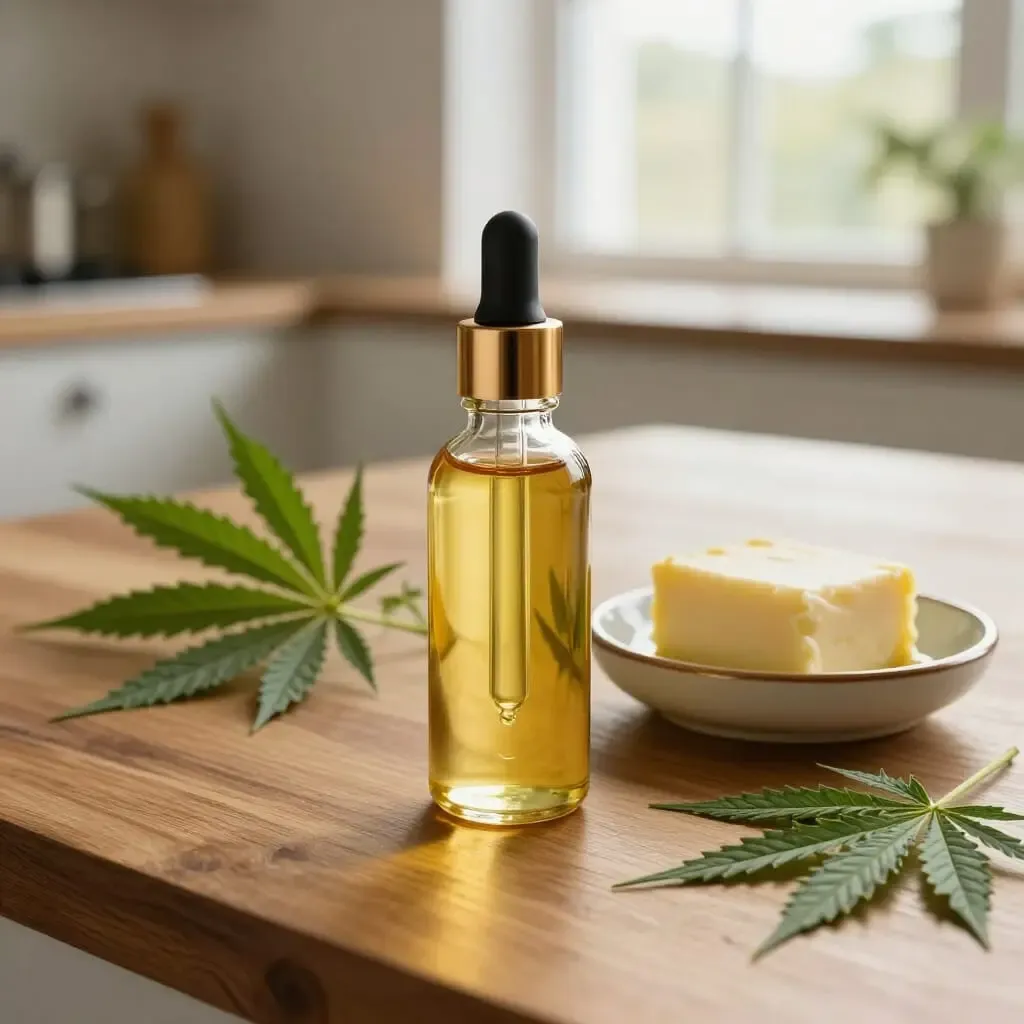
Cannabutter & CBD Oil Calculator | Precise Dosing Tool
Making cannabutter or CBD-infused oil without carefully calculating your doses is a recipe for disappointment—or discomfort. This CBD cannabutter calculator lets you determine the exact CBD content per serving and the optimal dosage for your infusion, based on your own parameters: amount of starting material, CBD percentage, volume of butter or oil, and desired number of servings. Whether you’re a CBD enthusiast looking to work this cannabinoid into your everyday cooking or a home cook wanting full control over your CBD recipes, this tool gives you a reliable foundation for your kitchen preparations.
Cannabutter & CBD-Infused Oil Calculator
Calculate the CBD amount per serving and the optimal dosage for making cannabutter or CBD-infused oil based on your parameters.
How to use the Cannabutter & CBD-Infused Oil Calculator: step-by-step guide
Step 1: Enter your starting CBD amount
Enter the total amount of CBD available for your infusion, in milligrams (mg). You can base this on the label of your CBD flower, isolate, or concentrate. For example, if you’re using 10 grams of flower at 10% CBD, you have 1,000 mg of total CBD to work with.
Step 2: Select your fat base (butter or oil)
Choose whether you’re making CBD cannabutter or a CBD-infused oil. Then specify the total volume of your fat base (in grams or milliliters). The type of fat you use affects cannabinoid absorption: clarified butter and coconut oil are particularly effective thanks to their high saturated fat content.
Step 3: Enter your estimated extraction rate
Not every infusion captures 100% of the available CBD. The calculator lets you input a realistic extraction rate (typically between 60% and 90%, depending on the method used). This variable is key to getting a reliable estimate of the CBD actually present in your finished preparation.
Step 4: Set your number of servings
Enter the number of servings you want to get out of your batch. The calculator will automatically divide the total extracted CBD by this number to give you the exact concentration in mg per serving.
Step 5: Read and interpret your results
The calculator displays the CBD concentration per serving (in mg), as well as the total dosage of your cannabutter or infused oil. You can adjust your inputs in real time to find the perfect balance between dosage and serving count for your CBD recipe.
How it works: the CBD dosage calculation formulas
The cannabutter and infused oil calculator relies on simple but rigorous math, tailored to the specifics of fat-based infusions.
Base formula:
Total extracted CBD (mg) = Starting CBD amount (mg) × Extraction rate (%)
Then:
CBD per serving (mg) = Total extracted CBD (mg) ÷ Number of servings
For example, starting with 1,000 mg of CBD, at a 75% extraction rate, and 20 servings:
- Extracted CBD = 1,000 × 0.75 = 750 mg
- CBD per serving = 750 ÷ 20 = 37.5 mg per serving
The calculator also factors in concentration per gram or milliliter of your finished preparation, letting you fine-tune your dosage based on how much butter or oil each recipe calls for. This level of precision is especially useful when you’re using your cannabutter across different dishes (cookies, sauces, dressings) that don’t all call for the same amount of fat.
CBD cannabutter and infused oil: understanding the basics
Why is dosing so critical in CBD recipes?
Unlike other ways of taking CBD (sublingual oils, capsules), eating CBD through recipes comes with a longer onset time (30 minutes to 2 hours) and bioavailability that varies from person to person based on metabolism and diet. Without precise dosing, it’s very easy to underdose—or, on the flip side, to blow past your comfort threshold.
Getting your cannabutter dosage in mg or your infused CBD oil dosage right lets you:
- Reproduce your recipes reliably batch after batch
- Build up your dosage gradually, starting with low doses (5 to 10 mg per serving) and increasing as needed
- Avoid wasting expensive CBD flower or isolate
- Share your recipes with other CBD users with full transparency about concentrations
Nutrition professionals and herbal medicine experts generally recommend starting with low doses—especially for people new to CBD—and adjusting based on individual response.
Butter or oil: which fat base should you choose for your CBD infusion?
Your choice of fat base affects not just the texture and flavor of your dishes, but also how efficiently the cannabinoids extract. Since CBD is a lipophilic molecule (fat-soluble), it binds preferentially to fatty acids.
Coconut oil is often considered the best base for a CBD kitchen infusion: its high concentration of medium-chain triglycerides (MCTs) promotes efficient extraction and good bioavailability. It’s ideal for cookies, brownies, or other sweet treats.
Clarified butter (ghee) also offers excellent extraction properties thanks to its high fat content. Its rich flavor works beautifully in savory recipes (sauces, pasta, bread) or traditional baked goods.
Olive oil, while less efficient in terms of extraction rate, remains a popular choice for dressings, marinades, and Mediterranean-style dishes. It brings its own nutritional benefits alongside the CBD.
| Fat base | Estimated extraction rate | Best culinary use |
|---|---|---|
| Coconut oil | 80 – 90% | Baking, sweet recipes |
| Clarified butter | 75 – 85% | Cooking, savory recipes |
| Olive oil | 60 – 75% | Dressings, marinades |
| Regular butter | 70 – 80% | Baking, spreads |
Best practices for making CBD cannabutter or infused oil
Decarboxylation: a step that’s often overlooked
If you’re using CBD flower to make your cannabutter, decarboxylation is a non-negotiable step. This process involves heating the plant material at a precise temperature (typically 225–250°F / 110–120°C for 30 to 45 minutes) to activate the cannabinoids and maximize their availability during infusion.
Skip decarboxylation, and a significant portion of your CBD will remain in its CBDa (cannabidiolic acid) form, which is far less active. This potential loss should factor into your dosage calculation—something you can adjust in the calculator via the extraction rate.
Infusion techniques: which method should you use?
There are several ways to make a CBD butter infusion or CBD-infused oil at home:
-
Stovetop infusion (slow simmer): Heat your fat base and CBD over very low heat (140–175°F / 60–80°C) for 2 to 4 hours. Simple, but it requires constant monitoring to avoid exceeding the critical temperatures that degrade CBD.
-
Double boiler: This gives you better temperature control and a gentler, more even infusion. Great for beginners.
-
Slow cooker: The most hands-off and reproducible method. Set it to “low” and let it infuse for 4 to 6 hours. A slow cooker maintains a stable temperature, which is ideal for preserving the CBD’s properties.
-
Dedicated infusion machine: Specialized devices (like the Magical Butter Machine) automate the whole process and deliver consistent extraction rates—particularly useful for regular users.
Whichever method you choose, running your numbers through our CBD infusion calculator beforehand lets you lock in your ratios before you even start cooking.
Frequently asked questions about the CBD cannabutter calculator
How much CBD do I need to make cannabutter?
It depends on your target dosage per serving and how many servings you want. As a general guideline, for 20 servings at 10 mg of CBD each, you’ll need at least 250 to 300 mg of starting CBD, accounting for a 75–80% extraction rate. The calculator will give you the exact figure based on your specific inputs.
Does the calculator work with CBD isolate as well as flower?
Yes. Whether you’re using CBD flower, isolate (around 99% pure), distillate, or another concentrate, all you need to do is enter the total mg of CBD in your starting material. The calculation works the same way regardless of the source.
How do I know what extraction rate to enter into the calculator?
The extraction rate varies depending on your method and fat base. As a rough guide: 80–90% for a coconut oil slow-cooker infusion, 70–80% for standard cannabutter, and 60–75% for an olive oil infusion. If you’re unsure, a conservative 70% is a safe starting point.
How many mg of CBD per serving is recommended for beginners?
People new to cooking with CBD typically start with 5 to 10 mg per serving. It’s best to wait 1 to 2 hours and observe the effects before considering a second serving, given the longer onset time of the oral route compared to sublingual use.
Can cannabutter be stored, and for how long?
CBD cannabutter keeps in the refrigerator for 2 to 3 weeks, or up to 3 months in the freezer. CBD concentration stays stable over time as long as the butter is stored away from light and heat. It’s a good idea to label your batches with the mg-per-gram concentration so you can dose accurately every time you use it.