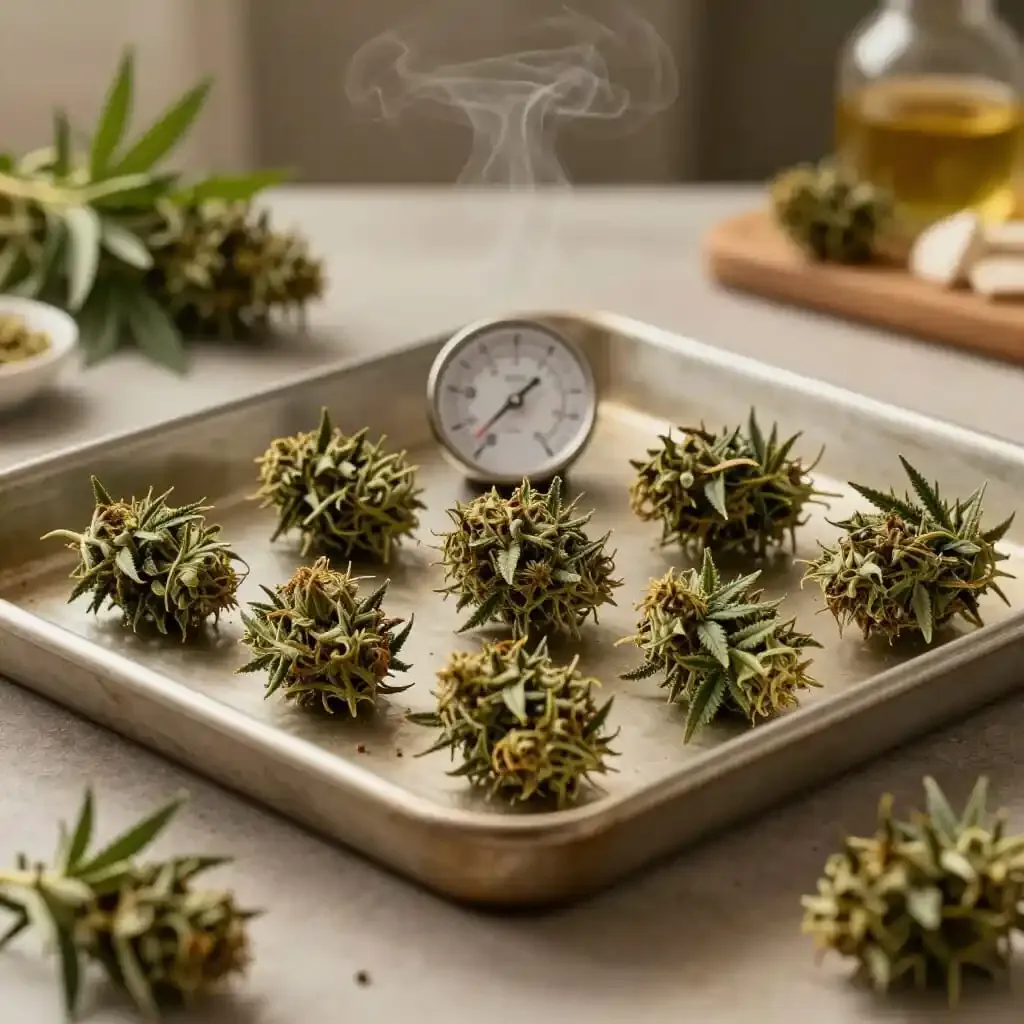
Decarboxylation: Turning CBDA into Active CBD
Definition
Decarboxylation is the chemical reaction that converts CBDA (cannabidiolic acid) — the raw, largely inactive form of the cannabinoid found in fresh hemp plants — into active CBD. This conversion happens under heat, which removes a carboxyl group (CO2) from the molecule.
Usage Context
Raw hemp, as it grows, contains mostly CBDA rather than CBD: without decarboxylation, that CBDA stays largely inactive in the body. Manufacturers typically carry out this step during drying, curing, or extraction, using controlled heat exposure. In CBD cooking, decarboxylation is essential when starting from raw hemp flower: baking it at a low oven temperature, around 220–250°F (110–120°C), for a few dozen minutes before infusing it into a fat is the step that makes the CBD actually available to the body.
Key Takeaways
- Decarboxylation converts CBDA (largely inactive) into active CBD through heat.
- It happens naturally and slowly during hemp’s drying and storage, or quickly under controlled heating.
- A temperature around 220–250°F (110–120°C) for 30 to 45 minutes is commonly used to decarboxylate hemp flower in the oven.
- Without this step, a recipe made from raw flower delivers almost no active CBD.
- Store-bought CBD extracts and oils are already decarboxylated during manufacturing.
Related Terms
- CBD — the active cannabinoid obtained after decarboxylating CBDA.
- CBD Infusion — a preparation that requires pre-decarboxylated flower to actually be effective.
FAQ
Do CBD flowers need to be decarboxylated before cooking with them? Yes, if starting from raw, unprocessed flower: without prior heating, the CBDA it contains stays largely inactive in the body.
What temperature should be used to decarboxylate hemp? A moderate temperature, around 220–250°F (110–120°C) for 30 to 45 minutes, is generally recommended to activate the cannabinoids without excessively degrading the terpenes.
Are store-bought CBD oils already decarboxylated? Yes, this step is part of the manufacturing process, so there’s no need to redo it with a finished product.