CBD Melting Point: Definition & Uses
Definition
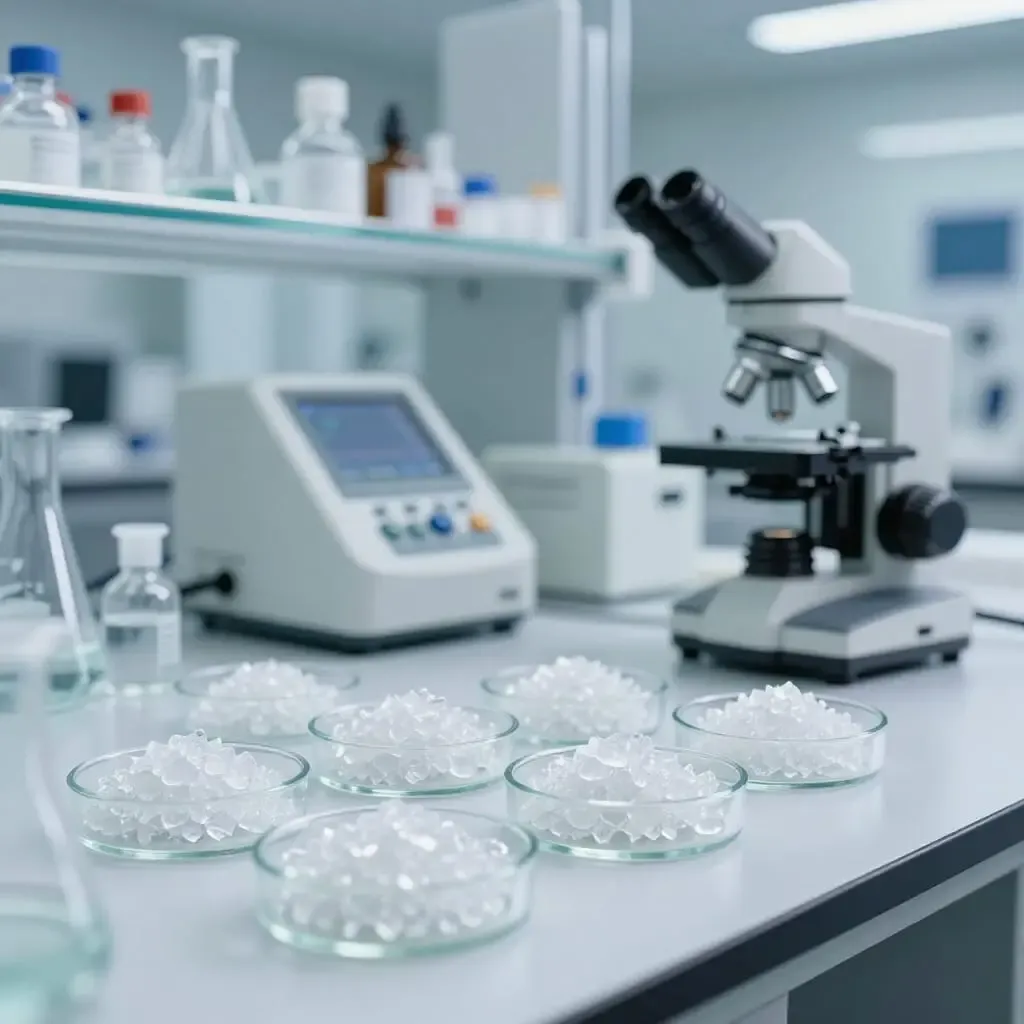
The CBD melting point is the temperature at which pure cannabidiol, in its crystalline (isolate) form, changes from a solid to a liquid state. For high-purity crystalline CBD, this temperature is generally between 62 and 68°C (144–154°F), depending on the source and measurement protocol used. Below this threshold, the crystals remain solid; above it, they melt into a clear liquid that is miscible in a fatty carrier.
Context of use
This figure matters mainly for formulation, not everyday cooking. To dissolve CBD crystals into a carrier oil (MCT, olive, coconut) or into an e-liquid base, the mixture needs to be gently heated above the melting point — in practice, often around 70 to 80°C (158–176°F) — so the crystals fully dissolve into a homogeneous liquid, with no clumps or residue at the bottom of the bottle. It’s also a quality-control marker: an isolate that doesn’t melt cleanly within this range, or that leaves a residue, often points to insufficient purity or the presence of other compounds (waxes, residual terpenes). The melting point should not be confused with the decarboxylation temperature (110–120°C / 230–248°F, a chemical reaction on raw CBDA) or with the boiling point of CBD, reported at around 160–180°C (320–356°F).
Key takeaways
- The melting point of pure crystalline CBD generally falls between 62 and 68°C (144–154°F).
- A CAS technical data sheet (13956-29-1) references a range of 62–63°C; a recent analytical chemistry study measured about 68.3–68.6°C on a high-purity isolate.
- The gap between values reflects differences in purity and crystal form, not a measurement error.
- When formulating oils or e-liquids, heating typically goes above this temperature (70–80°C) to fully dissolve the crystals.
- Not to be confused with decarboxylation (110–120°C, a chemical reaction) or the boiling point (160–180°C).
Related terms
- CBD isolate — the pure crystalline form of CBD for which the melting point is measured.
- MCT oil — a carrier oil commonly used to dissolve CBD crystals above their melting point.
- Decarboxylation — the chemical conversion of CBDA into CBD, not to be confused with the simple physical melting of the crystals.
- Terpenes — aromatic compounds whose presence can alter the melting behavior of a non-isolate extract.
FAQ
What is the exact melting point of CBD? There isn’t a single fixed value: pure CBD crystals generally melt between 62 and 68°C, depending on purity and the measurement protocol used.
Why does this temperature matter in CBD cooking or formulation? Because the mixture needs to be heated slightly above this threshold to fully dissolve CBD crystals in an oil or e-liquid base, without clumps or residue.
Is the melting point the same as the decarboxylation temperature? No: decarboxylation (110–120°C) is a chemical reaction that converts CBDA into CBD, while the melting point (62–68°C) is simply a physical change of state for CBD crystals that are already active.
Sources
Melting point referenced in the CAS data sheet 13956-29-1 (ChemicalBook) and measured experimentally in Densities and Viscosities of Cannabis Extracts and Distillates, and Densities, Viscosities, Fusion Enthalpy, and Melting Point of Cannabidiol, Journal of Chemical & Engineering Data, 2023.